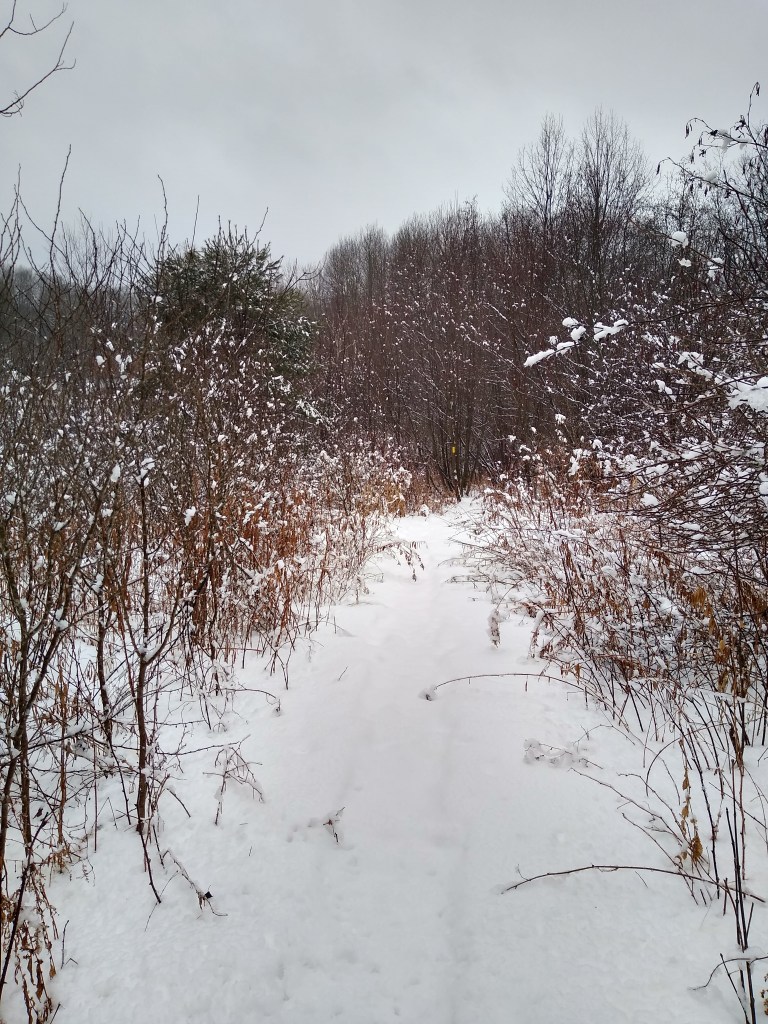
A challenging trail plus difficult weather conditions made for arguably one of my toughest hikes on the IAT when I hiked the 7.6 mile Chippewa Moraine Segment on Friday, January 15th.
Surprisingly, I had a terrible night’s sleep Thursday night, especially considering that I had hiked over 20 miles the previous two days. I think there were two reasons for this. First, I collapsed on my bed after Thursday’s hike and slept a good hour and a half. Normally, I really manage my naps – no more than 30 minutes a nap. The result was that I paid the price when it was really time to sleep. Plus, it was snowing heavily, and I could hear the scraping of plow blades in the lots of nearby businesses. I wondered what would greet me when I woke.
5:30 a.m. came, the alarm went off, and I was up and moving with about three hours’ sleep under my belt. The area was being socked with a “wintry mix”. Main highways were in surprisingly good shape, and I made my way to the trail head, where I would meet with Vicki, the local chapter coordinator and my trail angel for this hike. In the Small World Department, Vicki was a high school student at Brookfield East High School, where I taught. She graduated the year before I began teaching.
As I mentioned, the main roads were in good winter driving shape. I could not say the same for County M and the side roads, which were covered with a layer of wet, slushy snow. Climbing snow-covered steep hills in my front wheel drive car was not a given. My destination was a small boat landing along Plummer Lake, where Vicki was waiting for me. Nothing had been plowed. Although I could make it up the landing’s ramp, I needed a running start. It struck me as a dicey proposition.
Vicki was watching me work out this problem, and she was trying to help me arrive at a solution. Almost at the same, Vicki and I spoke the answer. Why not reverse the hike? the parking lot at the other end of the segment was flatter and very driveable – I had tried it the day before. Voila! We convoyed there, parked my car, and doubled back to Plummer Lake in Vicki’s truck. She dropped me off, and I started my 7.6 mile trek from east to west.

The first mile of the hike wound around the north shore of Plummer Lake and crossed the ice-walled lake plain shone in the picture above before entering more wooded terrain. As a reminder, ice-walled lake plains are “Mesa-like hills that were once lakes on a melting glacier. Streams flowing on the glacier deposited loads of sediment into these lakes. When the surrounding glacier had completely melted, the lake bottoms became the hilltops”(from the Ice Age Trail Guide).
After the first mile, the trail entered much more wooded terrain – wooded and filled with countless steep hills and kettle lakes. On this day, it was rare if I stopped anywhere on the trail without having a view to at least one lake. Periodically, I would pass signs explaining various features of the trail, including the sign explaining all the hills and kettle lakes.

The three inches of heavy, slushy snow made the hike all the more challenging. Footing was treacherous, particularly when I hiked on parts of the trail that were built into hillsides, but banked the wrong way. I put on microspikes in the hope that these “chains on my feet” would help my traction. No such luck. In fact, they made things worse because each step would cause me to pick up a big glob of wet snow and ice. This made me feel as if I was hiking with ankle weights. I did this for a little more more than a mile before removing them in disgust.
Ultimately, I adjusted my form to make my walking more effective. First, I shortened my stride to avoid the situation of taking a long stride, planting my foot and doing the splits (surprise!) when my lead foot would go out. Second, I made a point of really making contact all the way through my foot strike – kind of like dancer really working the floor. This helped me avoid shuffling along, and it provided a kind of early warning system if I started to slide. Last, I made heavy use of my walking sticks to help me retain my form and balance. All this helped a lot, but there were times I was just fated to slip and slide.
As you might expect, I was working hard throughout my hike, and I built up a lot of heat. I was grateful that I dressed lightly to avoid overheating and that my outerwear had vents that I could open as needed.
Outside of meeting a couple and their very well trained dog at about the halfway point on the trail, I was alone the entire hike. I had no contact with animals on the trail, although I saw scads of tracks across my path. I must have been maintaining a good pace because it felt like I finished the hike fairly quickly.
Originally, I was going to drive home right after the hike. I canned that idea the night before because I thought the bad weather might extend into the next day. It was a good choice. I was beat.
 My Days on the Ice Age Trail